Sauna planning
You need to make many important decisions when constructing a sauna. Among other things, you must choose a proper sauna heater. The size and construction of the sauna room, and personal preferences, affect the choice of heater power.
Important factors to take into account:
- Type of sauna heater: decide between an electric sauna heater or wood-burning sauna stove.
- Location of the sauna: small indoor settings or apartments, outdoor buildings, barrels or cabins, home spas or wellness centers etc.
- Location of the heater: on the wall or on the floor.
- Determine the capacity of a suitable heater: People tend to underestimate matters concerning the capacity of the sauna heater. Calculating the required heating capacity for a specific sauna is the key to an enjoyable sauna session.
The calculated cubic size of the steam room is calculated by adding the additional volume of non-insulated surfaces (a glass door or a glass wall, a non-insulated wood or log wall) to the cubic meters of the room.
Use our sauna calculator to find the heater power best suited to the estimated volume of your steam room.
Proper insulation in a sauna is essential to maintain a consistent and efficient heat level, reducing energy consumption and ensuring optimal performance of the heater.
It prevents heat from escaping and protects surrounding structures from moisture damage caused by high humidity. Without proper insulation, heating costs increase, and the sauna may fail to reach or retain the desired temperature.
Over time, the wooden materials used in the sauna room may begin to darken due to the high temperature. This is a natural process that does not pose a risk and is usually caused by the darkening of the wood or the wood protection product used. The darkening process can also be caused by the fine stone dust, breaking away from the sauna stones and lifted up by the airflow.
Proper ventilation in a sauna ensures even circulation of temperature and humidity throughout the room. It prevents the “cold feet effect,” where the air near the floor feels cool and the upper layers are hot. Correct ventilation avoids layered air, providing users with a comfortable and consistent sauna temperature, enhancing the sauna experience.
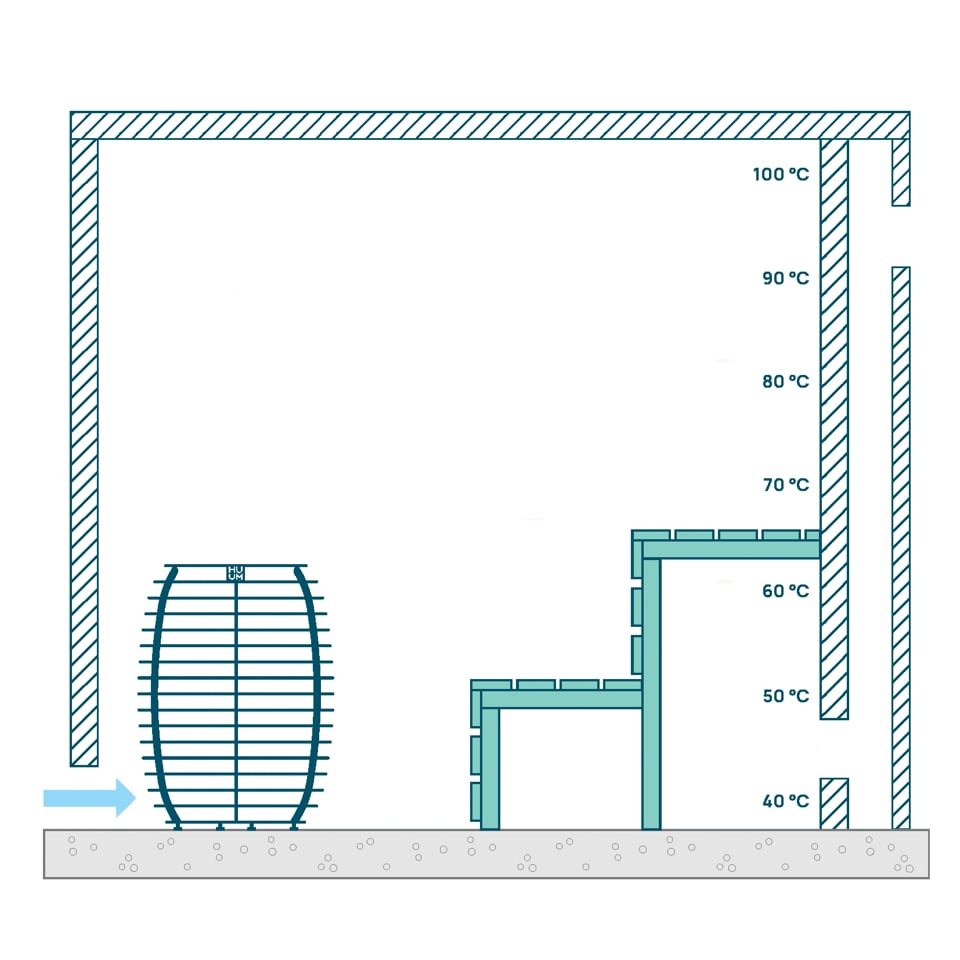
In general, the supply air pipe should be positioned close to the stove at the proper height, so that the incoming colder air reaches the heat of the stove, heats up, and creates circulation in the room.
The exhaust air pipe ensures proper ventilation by allowing stale, humid, and hot air to exit, creating a continuous airflow. Typically, the exhaust air pipe is installed close to the floor and opposite the air intake.
Read more about ventilation here.
Yes. Without proper airflow, electric or wood-burning sauna heaters may overheat or fail to heat evenly. Fresh air supports combustion in wood-burning heaters and heat circulation in electric models.